
How many people are gifted? What statistics say
2.3% of the population, or one person in 44. This figure is not quoted: it is demonstrated. And it explains why the proportion is the same everywhere.
The figure is not measured. It is calculated.
You read everywhere that gifted people (HPI in French) would be "2.3% of the population", without ever knowing where the number comes from. It comes from the very construction of the scale.
The intelligence quotient is not a quantity that one would record, like a height or a weight. It is a normalized score: the Wechsler scale is built so that results are distributed according to a normal distribution with a mean of 100 and a standard deviation of 15.
In other words: the shape of the curve is decided in advance. It does not describe a discovery, it describes a measurement convention. That is why the proportion of gifted people is the same in France, worldwide, and in any population: it does not depend on the people, it depends on the rule that defines the score.
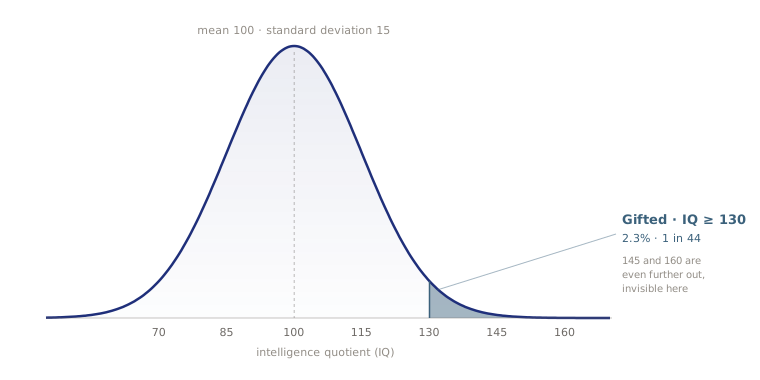
A threshold of 130 is exactly two standard deviations above the mean. The share of the population that exceeds it is therefore a property of the normal distribution: 2.275%. No survey is needed to establish it - and none could disprove it.
Three thresholds, and a rarity that collapses
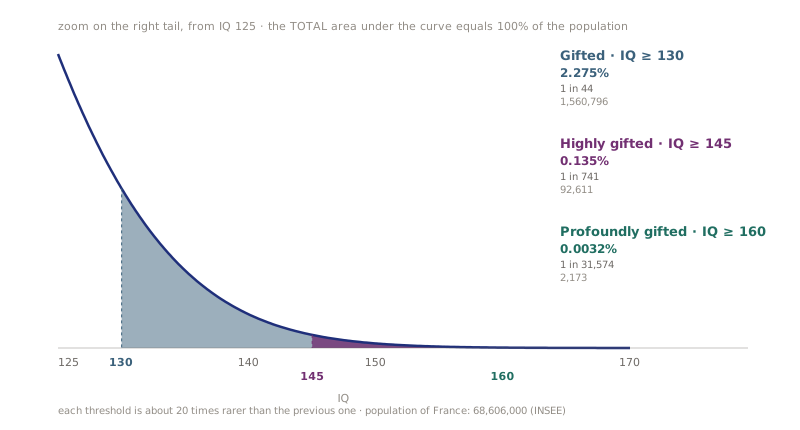
Each step is about twenty times rarer than the previous one. On the whole curve, you cannot see it: you have to zoom in on the tail.
| Threshold | Share of the population |
|---|---|
| Gifted - IQ ≥ 130 (+2 standard deviations) | 2.275% · 1 person in 44 · about 1,560,800 in France |
| Highly gifted - IQ ≥ 145 (+3 standard deviations) | 0.135% · 1 in 741 · about 92,600 in France |
| Profoundly gifted - IQ ≥ 160 (+4 standard deviations) | 0.0032% · 1 in 31,574 · about 2,200 in France |
Numbers calculated on a population of 68,606,000 people (INSEE, 1 January 2025).
One person in 44: what it means for your headcount
If gifted people are distributed at random in the working population, an organization has, on average, a little over 2 per 100 employees.
- An SME of 50 people: about 1 gifted employee.
- An SME of 200 people: about 4 or 5.
- A mid-sized company of 1,000 people: around twenty.
What we will not say
You will read elsewhere that a given sector "attracts" more gifted people, backed by coefficients. We found no study that establishes it, and we will not invent it. The same goes for what a departure would cost: the amounts in circulation rest on nothing published.
What statistics allow us to say stops here. The rest comes from observing your organization - which is precisely our trade.
The number, in any case, is not the question. A gifted person who is poorly used produces no more than anyone else. What changes an organization is not counting them, it is the cross-functional reading that these profiles make possible - and the method that makes it accessible to everyone. The business leaders concerned have their own page: Gifted business leader.
What we are asked most often
What percentage of the population is gifted?
How many gifted people are there in a company?
What is the difference between gifted, highly gifted and profoundly gifted?
Why is the proportion the same everywhere?
Does IQ tell the whole story of a gifted person?
Is your organization making use of what it already has?
A first strategic interview, free and with no obligation.
Free strategic interview