
Change in business
By Charley Fredaigues
- Organization
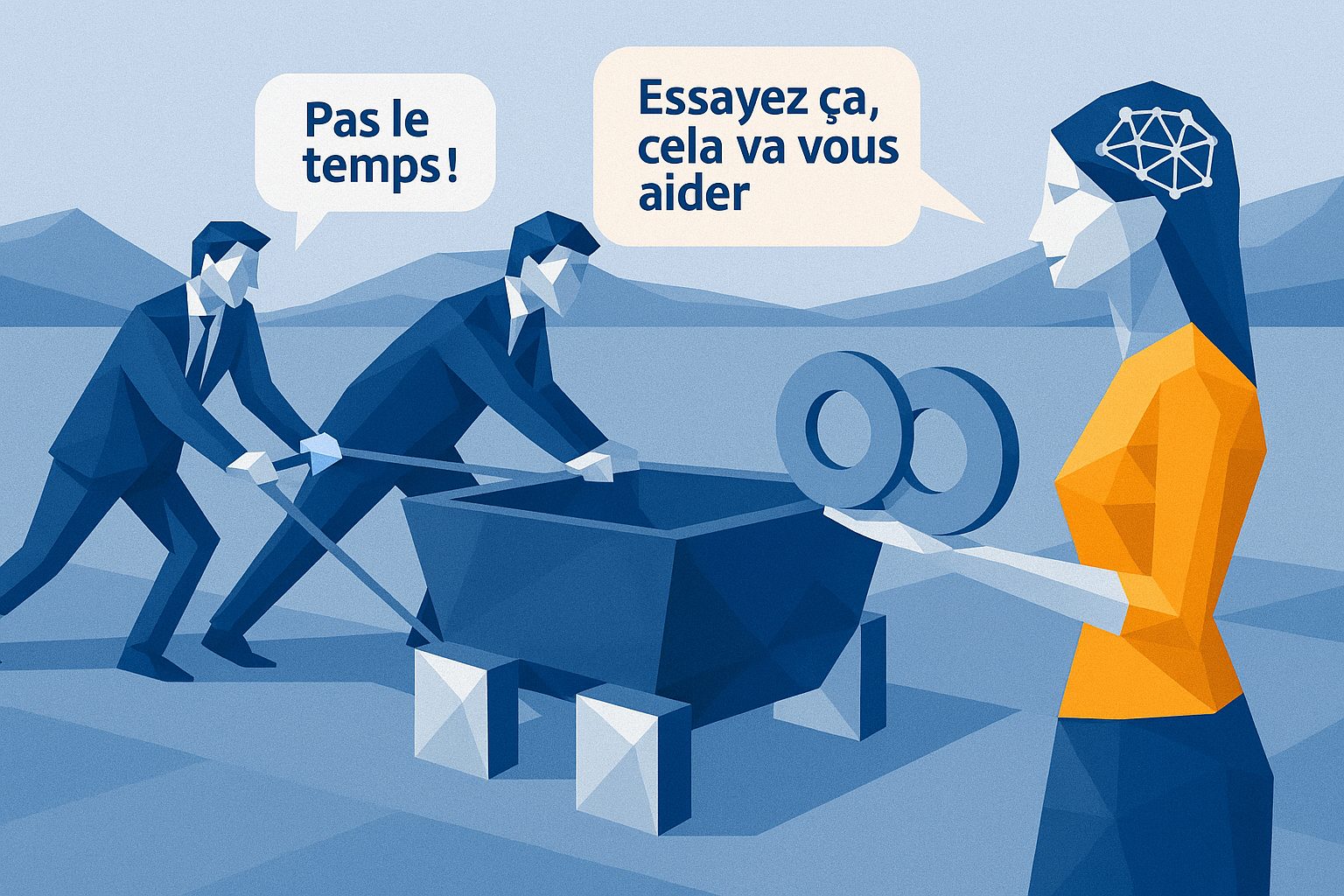
Drawing on nature to understand how companies evolve
" The world has changed "
In reality, the world is as it has always been and always will be: in permanent evolution. Change in business is supposed to follow the same rules.
Nature teaches us this every day: organisms, living beings, plants, animals, evolve by adapting to the world around them. The species that fail to adapt gradually disappear and then die out.
We must be humble, we humans, as a species endowed with a "superior intelligence", in the face of this reality of the world. We too are a species with a variable physical capacity to adapt: we can survive or disappear like any other species.
Why a variable capacity to adapt?
Because we physically cannot adapt to everything in a short time, even over several generations. An extreme acidification of the oceans would not leave us the time we need to adapt; it is physical and temporal. Even with the best of intentions, the best of dreams, the best trust in science. It is somewhere in this space, incidentally, that elements of the border between fiction and reality are to be found.
Setting aside the changes that are out of reach because of physical limits, fortunately many remain that may be attainable... or not.
In those cases, the limits will this time be mental, and once again with a variable mental capacity to adapt.
Resistance to change in business
The famous resistance to change is inherent in any organism with a brain. Because the brain, however fabulous it may be, is easily drawn to the usual mechanisms that consume the least possible energy.
For most organisms, the brain is frugal, and therefore resistant by nature to any change. The brain is our most protective instrument for surviving any situation; if it is afraid of change, it will refuse it.
The main variable of adaptation is neurological functioning
Now that we see that how the brain works will influence the capacity to adapt, it is easy to understand that not everyone is equal in adaptability and in the capacity to survive, to be resilient, to project forward and to cope with a complex world.
2 types of people exist and can (must) complement each other:
- Those who are comfortable with habitual ways of working, effective at carrying out projects, able to adapt to the instructions given that provide a reassuring framework. Efficient at producing in industrialized environments. In this first group we will mainly find neurotypical profiles.
- Those who are comfortable with uncertainty, with creation and intuition. Effective at inventing, revolutionizing, adapting, industrializing, conceptualizing. In this group we will find many neuro-atypical people.
The latter are neurologically the best equipped to adapt and to be less resistant to change.
What is this VUCA world?
The world is considered VUCA.
It is the acronym for Volatility, Uncertainty, Complexity & Ambiguity.
In plain language: unstable, unpredictable, tangled and unclear.
As we like to theorize everything or put new words on the obvious, this makes it possible to bring people along in explanations showing that man has created an ever more complex world in which he can no longer even find a way to simplify his life. Because alongside that, the natural world of our planet has remained just as simple, endangered of course, but simple.
Complicating our own lives is a characteristic of the human species. Other species do not bother with it. Which shows that the "superior intelligence" I mentioned at the beginning of the article is quite relative. But the reality is that we are indeed in this VUCA world.
Why volatile?
Because the need of one day may have changed the next, because an employee may resign tomorrow, because a customer may change their need overnight.
Why uncertain?
Because we do not know what will happen tomorrow; because with a cyberattack, the question is not "will it happen?" but "when?"; because we do not know when someone will resign, or even be dismissed.
Why complex?
Because everything is siloed, because information is not the same at each hierarchical level. Because beyond the hierarchical organization there are parallel organizations (relationships, cronyism, interests, ...)
Why ambiguous?
Because much information is not visible, and decisions are incomprehensible without having all the criteria. Because not everything is rational in appearance, because the parameters have become extremely numerous.
Is it irreversible?
"What was broken can be reforged" – Tolkien, The Lord of the Rings. Which translates as: what was made complex can be made simple again.
- Rome was powerful, Rome collapsed. Life went on, we forgot.
- Nazi Germany was powerful, Nazi Germany collapsed, life went on, and we are forgetting it (unfortunately).
- Today’s world is powerful... Let us build tomorrow.
Human adaptation in business
Or the adaptation of companies (made up of humans).
What is true of humans is true of groups of humans, such as a company.
Each company also has a variable capacity to adapt, depending on the humans who make it up. Each company can thus adapt or disappear; change in business is therefore a key component of the life of the company, a fully integral part of it.
What will differentiate a company that adapts from one that will disappear?
Quite simply, the humans who make it up. Well, not exactly; this is the moment when it is important to be really precise: the differentiating factor is the neurological functioning of the humans who make up the company and the power that is delegated to them... or not.
Neuro-atypical gifted people are people with a superior capacity to adapt. A capacity to be at ease in a complex environment because of their different neurological functioning. Less at ease with habits, but like a fish in water in shifting, complex environments, in short, VUCA ones.
Yet other people have a capacity to follow, to turn a creation, a design, into something concrete. They are able to produce what was imagined and bring it to life.
Both types of capacity are indispensable: an idea that is not produced remains an idea. We need those who imagine and those who implement. We need those who think about adaptation and those who reinforce it.
But why does it get stuck if it is supposedly so simple?
Why do gifted people disturb?
In French, an "I" was added after High Potential: from HP, the label became HPI (high intellectual potential). A term was added that hits the ego head-on. "Why would I be less intelligent?"
Intelligence was reduced to the Intelligence Quotient (IQ), whereas there are multiple intelligences (see Gardner’s theory), which lists a number of them.
- Linguistic intelligence
- Logical-mathematical intelligence
- Spatial intelligence
- Intrapersonal intelligence
- Interpersonal intelligence
- Bodily-kinesthetic intelligence
- Musical intelligence
- Naturalist intelligence
- Existential intelligence
The real subject is not intelligence but neurological functioning.
Instead of reinforcing complementarity, difference was banished. In France especially, we have amputated ourselves of a richness. Our competitors value it... the US, Canada... Should we see here an inability to be competitive in France?
How the brain works is not explained simply: no lessons are given on what cognitive biases are (this should be mandatory), nor on nonviolent communication, nor on accepting difference and divergence. In this reactive world we forget to think, to reason. We use the reactive capacities of our brain and less and less its capacities for reasoning, for questioning, for considering criticism, divergence and disagreement as sources of enrichment.
We fight ego battles, we dig in on commitment biases (which could be called stubbornness biases) until we hit the wall.
Only 8% of employees are engaged in France in 2024. This should force questioning, humility and openness, but like any change we face the famous change curve, the grief curve. We resist this reality, we get angry, we carry on in denial, yet the solution is right there: before our eyes, within reach of everyone: let go of misplaced pride, regain simplicity and authenticity.
How to change simply?
Okay, but how do we do it if it really is that simple?
Coping with a complex world is actually rather simple. You just have to stop the infernal circle of complexification.
Change frightens almost everyone. For some, who are often neuro-atypical gifted people, it is their field, their strength. Why? Because they see far ahead, they know where to go and how to get there, even if it will be hard, even impossible, for them to explain.
Translating the reasoning of a neuro-atypical person means:
- Losing part of the message in words that will never represent all the dimensions of a branching structure
- Losing part of it in the attempt to translate into a neurotypical language
- Losing part of the understanding, because branching thought cannot be fully understood by sequential thought
Analogy: You do not convert a 4-dimensional film (3 + time) into a single, static 2-dimensional image and hope to understand the whole story.
In short, it is wiser to entrust change to those who are not afraid of it and to follow them, rather than asking them to explain everything.
The challenge is not to understand the approach but to understand (and integrate) the difference.
A business owner who understands the added value of how the brain of a neuro-atypical gifted person works will know how to entrust them with their transformation.
The challenge is to consider difference, dissonance, criticism, the thorn in the side, alerts, different viewpoints, multipotentiality, originality, vivacity. To consider contradictory information.
Around you, you more often have people who tell you what you want to hear, not what you need to hear.
It takes far more courage to carry a dissonant voice against a whole group than a conforming voice in the image of a flock of parrots. Courage is a mark of intelligence, and above all of engagement. Listen to engaged people: they are increasingly rare.
PS: engaged by no means refers to those who have the most to gain individually and who make you believe they are engaged. Engaged means for the company; there is an altruistic notion in it, a notion of pleasure in working and in contributing.
How do we know whether we need to change?
We must not change: we must evolve permanently.
The question is rather how to know whether we are evolving in the right direction or not.
Figures show a financial "reality", or rather a perception of financial reality. They show good health at a given moment, but do not take into account at all the many other parameters that can violently affect profitability and growth.
Why "reality" in quotation marks: because production or operational reality is rarely measured faithfully. Projections are used, optimistic assumptions pegged to prepared budgets (which do not account for risks), in the absence of more precise figures. It can of course be measured, but in every company that starts to do badly, we realize that these measurements were never taken.
Which indicators are relevant?
It is absolutely necessary to track production indicators, between what is planned and what is actually produced. These figures are rarely really measured in companies that are doing badly, or else the figures are very far from reality.
Then the best indicators for seeing far ahead are human indicators: if steering is failing, time spent has never measured real productivity, only maximum production capacity. On the other hand, the evolution of staff turnover indicators (involuntary), the measurement of engagement, should be followed closely, as should the measurement of the quality of management, which is very rarely done. And these indicators must be combined with operational and financial figures.
Only then can we say that we are fully steering.
- In motor racing: the diagnostic computer is plugged in to see what is wrong in the electronics, a driver runs tests to feel other parameters with an expert’s perception, and in the race, the corner is not missed.
- In some companies: steering is done with real data, people listen, pay attention to alerts, ask, see far ahead, and adapt by anticipating.
- In other companies, beliefs are sometimes discussed in the executive committee without real figures or without checking their reality, and then a corner is missed... End of the race.
Engagement
Engagement is the key to being competitive in an international environment. Winning that engagement must be the number 1 priority of every manager, every business owner, every HR director.
This automatically eliminates bad management: petty bosses, toxic managers, hot-air merchants, smooth talkers, and so on. The focus must be on providing coherence, ensuring consistency of communication, fairness, balance, meaning... in short, all those things that are ultimately obvious.
Beware: in an unsuitable environment, extreme engagement is dangerous. Highly engaged people will go to the breaking point, hence the importance of treating their engagement as a risk. The breaking point is burn-out.
Conclusion
There is no need to make a mountain out of change in business.
It is a natural movement, a permanent evolution that above all requires humility, lucidity and courage.
Understanding and working with (rather than against) the diversity of human functioning, valuing complementarities and daring to simplify rather than complexify: that is what allows organizations to stay alive in a VUCA world.
But between theory and practice there is a chasm: that of concrete implementation.
It is often in this space, incidentally, that many budgets are wasted on false hopes.
Audits that stop at the findings when they do not trigger rejection; consultants who produce studies so detailed that nobody dares go further; headhunting firms that propose profiles matching the request exactly (fitting the mold) without analyzing the real need.
"We cannot solve our problems with the same thinking we used when we created them"
Albert Einstein
Important: Accepting differences and divergences in no way means accepting mechanisms that tend to complexify, letting "we’ve always done it this way" endure, or denying the experience of seniors.
This is precisely where orgatypik comes in. We help business leaders and their teams by providing a strategic and operational complement, aiming for a strong return on investment.
The orgatypik goal: an optimized investment for a maximized ROI.
👉 If you want to go further, and discover effective methods to steer your transformations and improve your operations, I invite you to explore orgatypik.
Because evolving is not an option, but a condition of longevity.