
Securing decisions through divergence and disagreement
By Charley Fredaigues
- Organization
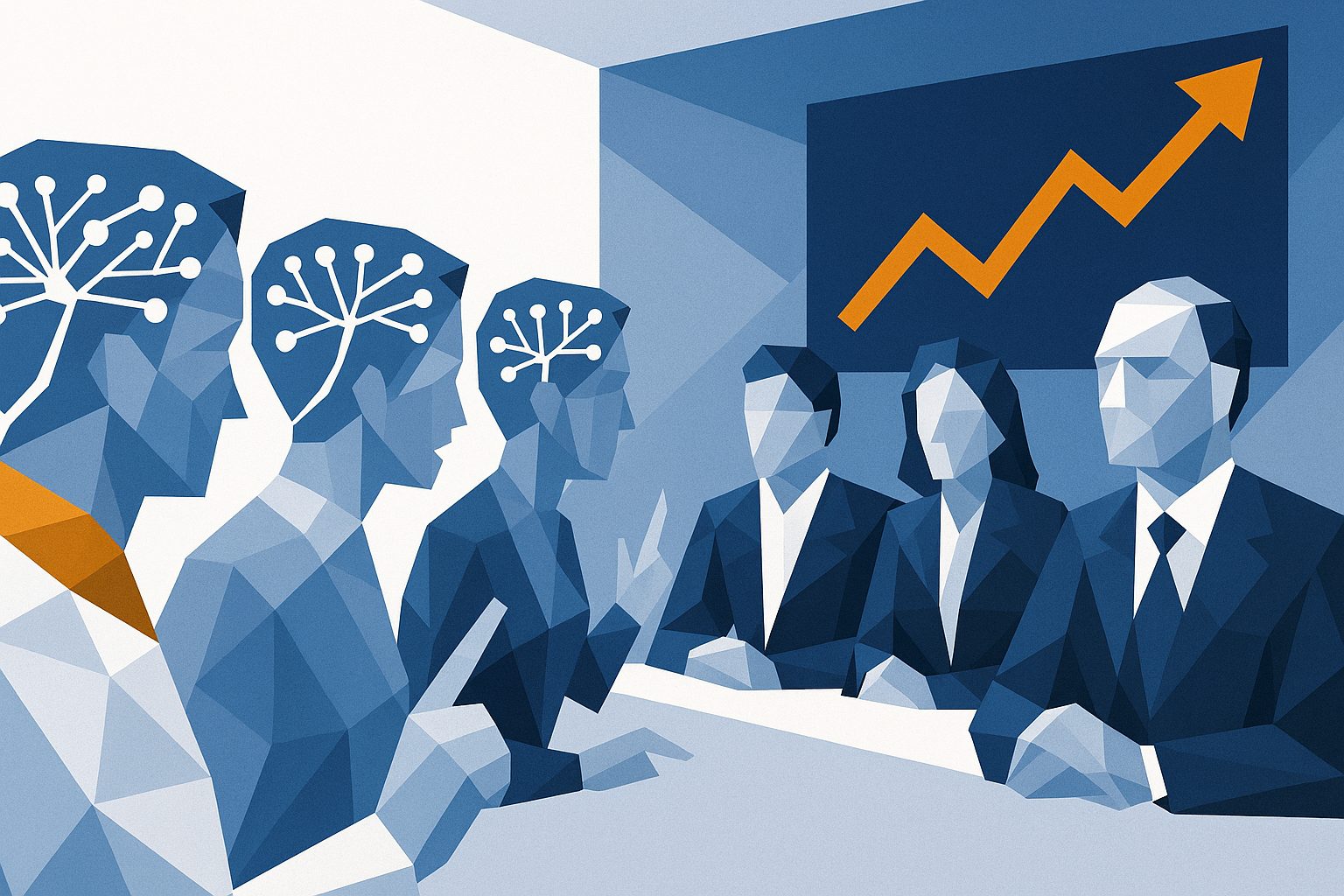
When conformism destroys: why consensual decisions without dissonant voices sabotage the company
Introduction
Picture a meeting room where everyone nods along. Not a frown, hardly an awkward silence, a fine unanimity. A lovely picture: but often terribly misleading.
Strategic or operational decisions made from an incomplete view, in organizations that push out divergence, can lead to human, moral and economic catastrophes.
Listening to opinions that challenge beliefs and including atypical cognitive profiles (neurodivergent, multipotential, "outsiders") are not a luxury. They are safeguards, and even levers of performance.
In this article, I will (1) examine the known dysfunctions when disagreement is stifled, (2) illustrate with real cases, (3) propose an inverted approach (cultivating dissonant voices) and (4) give operational examples that apply in business.
The trap of forced consensus: how do we get there?
The "group that is right" syndrome (groupthink)
The theory of groupthink (Irving Janis) describes the phenomenon where, in a very cohesive group, the desire for consensus outweighs critical examination of ideas. Members avoid conflict, censor themselves, and adopt an illusion of unanimity.
The classic symptoms:
- illusion of invulnerability, excess optimism
- collective rationalization, denial of contrary signs
- direct pressure on anyone who doubts
- self-censorship
- illusion of unanimity
- mind guards: those who filter discordant information before it reaches the group
- stereotyping of the adversary
- unquestioned belief in the morality of the group’s cause
When this dynamic sets in, even weak signals (timid alerts, doubts) are ignored, even suppressed.
The vicious circle of a rigid culture
In many organizations, the dominant culture values alignment, loyalty, adherence to management doctrine. This leaves little room for heterodoxy. If the hierarchy (or the founder, or the executive committee) gives the impression that the right decisions are already known, who will dare to object?
This way of working is reinforced by:
- the implicit (or explicit) fear of repercussions ("you’re not a team player")
- the signal sent (formally or not) that disagreement is frowned upon
- the homogeneous makeup of teams (similar backgrounds, training, personalities)
- the lack of structured processes to bring out dissent (no "devil’s advocate", no critique method)
- leadership that is too directive or charismatic
- overconfidence in internal models and the elite’s intuition
When you combine a rigid culture, silent voices and no feedback mechanisms, you settle into blindness.
Human and profitability consequences
The problem is not theoretical. Here is what it produces:
- demotivation, moral exhaustion, staff turnover: those who feel their voice does not count leave or fall silent
- poorly calibrated, unexpected decisions, made through a biased prism
- projects launched without taking risks into account (social, safety, legal)
- wasted resources, delays, costly errors
- loss of credibility, disputes (social, media)
- worse: human harm (safety, health), crises.
Real cases of decision bias
Challenger (1986): the failure of technical dissent
This is one of the most cited cases. Before the launch of the space shuttle Challenger, some engineers at Morton Thiokol (the booster contractor) warned of the risk of O-ring joint failure in cold conditions.
But within the decision group, management pressed for these warnings to be downplayed or ignored: the fixed launch date was politically and publicly heavy. Artificial consensus prevailed over contrary voices.
Result: the explosion 73 seconds after liftoff, the death of the seven astronauts.
What this case shows: even in an extremely critical setting (safety, engineering), when doubt is gagged, the irreparable can happen.
Swissair: the myth of corporate immunity
The story is less spectacular but instructive for the business world. Swissair, once Switzerland’s "flying bank", collapsed in 2001-2002.
The causes: a board that was homogeneous (ideologically and socially), a belief in the invulnerability of the Swiss brand, expansionist decisions that were not sufficiently challenged, a reduction of industrial expertise in governance, and a lack of internal warnings.
Result: bankruptcy, considerable financial losses, mass layoffs, a national crisis of confidence in the Swiss aviation sector.
Coca-Cola and the "New Coke" fiasco (1985)
Less dramatic but illustrative: in 1985, Coca-Cola replaced its original recipe with a "New Coke" version. The leadership committee was convinced the public would adopt the new, sweeter formula. But consumer opposition was massive, and the return of the "old Coke" under the name Coca-Cola Classic was unavoidable.
The problem: the decision makers did not want to hear contrary signals, were locked into their certainty, and underestimated the emotional attachment to the original version. Dissonance was systematically set aside. It is an example of "consensus bias" applied to product marketing.
The American automobile industry (late 20th century)
Not a single company, but a sector that rested on its laurels. In the 1980s and 90s, the big American carmakers (GM, Ford, Chrysler) often ignored or underestimated the emergence of Japanese manufacturers and the rise of compact, hybrid or more efficient cars. This collective conservatism, encouraged by an illusion of superiority, contributed to the drop in competitiveness.
These examples show that conformity bias is not the preserve of "soft" sectors: even technological, industrial and critical companies can fall into it.
Contemporary cases in neurodiversity and inclusion
On the subject of "putting neurodiversity to work": spectacular scandals are not yet that common, but there are cases of poor inclusive decisions that are paid for in lost innovation or internal conflict.
- In a Harvard Business Review report, it is argued that companies that embrace neurodiversity can gain a competitive advantage (better creativity, more divergent thinking), but many fail because they adapt recruitment and evaluation processes poorly, or do not tolerate different thinking styles.
- Deloitte documents cases where rigid alignment with neurotypical norms (e.g. expectations around verbal communication, classic interviews) eliminated good candidates with different cognitive profiles.
- The World Economic Forum observes that few neurodivergent people reach leadership positions, often because governance structures are not equipped to welcome them.
Changing paradigm: cultivating disagreement as a resource
Rather than betting on harmony, the goal is to civilize conflict, to build it in as a driver of rigor.
Here are the main lines, then concrete examples.
Founding principles
- Value conflict as a means of validation, not an obstacle
Reframe it for your team: "I want to know what could bring my idea down" rather than "I want everyone to approve it". -
Institutionalize dissonant voices
- appoint a "devil’s advocate" (or several) in each strategic meeting
- rotate the adversaries: everyone takes a turn giving criticism
- include heterogeneous cognitive profiles (neurodivergent, multipotential, people from outside the silos)
- run "pre-mortem" sessions: imagine the failure, which causes and which objections could have brought it about
-
Set up anonymous or semi-anonymous channels
If someone has a doubt but fears speaking up, offer safe spaces (suggestion box, internal survey, digital interface) to express discomfort. - Suspend hierarchical influence at the start of debates
Do not let the leader give their opinion first, to reduce the anchoring effect. Let everyone express their hypotheses first. - Speak in "hypotheses"
Phrase ideas as conjectures to test, not certainties. This opens the discussion. - Encourage critical feedback
Publicly value dissonant contributors (symbolic reward or recognition).
Train managers to receive criticism without emotional retaliation. - Set up divergence metrics
Example: in strategic meetings, measure the number of contrary opinions expressed. Or a "silence rate": who never speaks? - Feedback loops after the decision
After implementation, go back over the objections raised and those ignored, and compare what happened with what was anticipated.
Why it works (beyond a clear conscience)
If cognitive inclusion becomes a pillar of the decision-making process, it is no longer a bonus: it is a guarantee of a better result.
Applied example
Here is a fictional but realistic example:
In a tech SME, a product committee is preparing a major change to its software architecture. The technical team includes an autistic developer (HFA) who anticipates a performance bottleneck in the communication layer. As the meeting is dominated by the functional leads, he does not dare to speak. The manager imposes a "safe" option. A few weeks later, the release is slow, causing customer delays. In a post-mortem, it turns out the earlier warning was credible, but not heard.
If this team had appointed a "divergent" role, or set up an anonymous suggestion box, that voice could have been heard upstream. The cost of a non-decision (silence) has now become visible.
Neurodiversity, multipotentiality: levers of cognitive disruption
Concretely, how do we bring atypical cognitive profiles into the decision equation?
What neurodiversity brings to the debate
- Divergent and non-linear thinking: neuroatypical minds (multipotential, gifted, ASD, ADHD, dyslexia, etc.) can make cognitive leaps and unexpected associations. This can trigger unforeseen insights.
- Hyper-focus and great precision: some people on the spectrum can spot microscopic errors, patterns invisible to others.
- Systemic thinking, the ability to spot lateral links: multipotential people or cognitive "scanners" can connect different fields (tech, people, market)
- Tolerance of doubt: some profiles are used to working in uncertainty; their sense of vigilance is often sharp
- A questioning temperament: these profiles often feel the need to understand the "why", not just to execute.
If you put 10 very homogeneous profiles and 1 neurodivergent person in the same group, the disruptive potential is high... if that person is heard.
The real obstacles we have to face
- The normative culture (communication, pace, formats) expects the "neurotypical" mode
- Biases (we think an atypical profile "has a flaw", "a disability")
- The lack of accommodations (time, noise, meeting method)
- "Masking" (these people hide their particularities to "fit in")
- Self-censorship: they do not dare to speak, for fear of being "labeled"
Deloitte offers a methodological framework for integration (recruitment, management, adaptation). The World Economic Forum stresses that including neurodiversity in the leadership team makes it possible to "access untapped potential" rather than settle for tokenism.
Real cases or notable initiatives
- Several large technology companies (e.g. IBM) have launched "Autism at Work" or "Neurodiversity hiring initiative" programs. For example, IBM hires autistic people for software testing roles, where their attention to detail is valuable.
- Some initiatives in large firms consist of adapting interview processes: giving the questions in advance, accepting written rather than oral formats.
- On boards, some propose "mixing" members cognitively to avoid homogeneity.
- In tech, academic research (notably in software) examines how to include developers with ADHD or autism in modified agile methods (shorter sprints, adapted cadence).
These initiatives are not yet widely publicized, but they point in the direction I am pushing here: not believing that the "cognitive norm" approach is enough.
Operational implementation: a user guide
I know you want something concrete. Here is a step-by-step roadmap, to adapt to the size of your organization.
1: diagnose the culture of speech
- Map the silences: who never speaks in meetings?
- Study past meetings: were objections set aside?
- Survey anonymously: "what did you not dare to say?"
- Observe meetings: are there moments of tension, unexpressed signals?
2: train leaders and facilitators
- Train managers to receive criticism without reacting emotionally
- Raise awareness of cognitive biases (halo effect, confirmation bias, group bias)
3: design an "inclusive" meeting format
A few ideas:
- Start without the "boss’s" point of view: everyone submits their ideas on the spot (silent writing)
- Alternative speaking round: each person states what they see as risky
- Divergence workshops: "what could make this plan fail?"
- Breakout subgroups: small heterogeneous groups, then report back
- "Anti-option" vote: vote for the option you reject (this brings objections to light)
- A "cooling-off" pause: leave 24 to 48 hours, then return to the plan with a critical mind
- An anonymous feedback channel in parallel (digital tool or physical box)
4: recruitment and varied cognitive profiles
- In recruitment, add cognitive diversity criteria: look for those who think differently
- Provide accommodations (more time, a written version of the interview, clear instructions)
- Encourage co-optation (often "out of the norm" profiles do not appear in classic channels)
5: feedback loops and adaptation
- After each strategic decision, revisit the objections collected: which were ignored? why?
- Document the "useful dissent": the objections that proved right
- Adjust methods: what works / what does not / what needs to change
- Give feedback to the divergent participants: "your point allowed us to adjust this"
6: recognize, value, sustain
- Give visibility to those who criticize: it is often courageous
- Symbolically reward "useful dissonance"
- Include soft KPIs: number of dissonant opinions expressed, rate of buy-in after debate
- Write into the organization’s charter: "we do not punish objection"
Obstacles, resistance and how to face them
I will not pretend it is simple. Here are the main challenges, and a few ways to overcome them.
Cultural resistance
If the company is old, hierarchical, used to "top-down", many will consider this approach "too soft", "indecisive".
Remedy: start small (pilot), show gains, then expand.
Fear of conflict
One can be convinced that conflict destroys teams. A pacified culture finds the idea surprising.
Remedy: distinguish "destructive conflict" from "constructive divergence". Coach on metacommunication (how I say what I believe).
Cognitive overload
More debate = more time. In organizations in a hurry, "getting to the point" is often justified.
Remedy: calibrate the moments of divergence, not every debate deserves a major rethink. Prioritize decisions "with high stakes".
Cognitive selection bias
Even when wanting to diversify, we recruit "the same profile in disguise".
Remedy: call on external evaluators, diversify recruitment panels, ask candidates for "divergent decision" cases.
Tokenism and instrumentalization
Placing a neuroatypical person "for show" without real power.
Remedy: make sure these profiles take part in decisions, not in a decorative role. Power must come with voice.
orgatypik: the collective that helps companies think outside the box
The best-performing companies are not those that decide fastest, but those that know how to listen differently. In an environment where complexity dominates, ignoring divergent opinions often amounts to ignoring reality.
This is precisely where orgatypik comes in.
This collective brings together multipotential, gifted and neuroatypical people who have branching thinking and a rare capacity for cross-cutting analysis, all experienced at executive committee / C-level.
Their mission: to give business leaders an out-of-the-box vision, able to connect the dots that conventional thinking leaves in the shadows.
By bringing these profiles into the heart of strategic or operational thinking, companies gain on three fronts:
- More robust decisions, through the detection of biases and weak signals.
- Stronger capacity for innovation, born of cognitive diversity and constructive confrontation.
- Lasting competitive advantage, through finer anticipation of economic, human and technological change.
orgatypik acts as a collective intelligence partner, able to enrich decision processes without upsetting internal structures.
The goal: to turn cognitive difference into a lever of performance and resilience.
Because in the long run, the companies that dare divergence become the ones that call the tune.
Conclusion
The truth is that a company that barricades itself against discord is in a fortress: the fortress of illusion.
Those who build channels for divergence are not looking for chaos, but for robustness. By bringing in neuroatypical and multipotential voices, those often pushed aside, we do not "tolerate" difference: we summon it.
Performance feeds on constructive friction. The safest decisions are not those made without debate, but those subjected to the sharpest possible criticism before being settled.
You do not want the best average compromise, you want a choice that has survived the storm of objections, because the objections have strengthened it.
Sources
- "What Is Groupthink? Definition, Characteristics, and Causes"
- What Is Groupthink & Why It’s Bad for Business (Challenger, Swissair)
- Real-life examples of groupthink (Challenger, Pearl Harbor)
- European Business Review: Groupthink in Business, dangers and remedies
- Entrepreneur: How Groupthink Can Cost Your Business (Swissair)
- Deloitte Insights, Neurodiversity in the workplace
- Harvard Business Review (via Neurodiversity as Competitive Advantage)
- World Economic Forum: creating a neurodiverse leadership team
- Academic research: "A Socio-Technical Grounded Theory ..." (challenges of integrating neurodivergent people in software development)