
Governance, steering, management: the fatal gap that AI and your project management software do not fill
By Charley Fredaigues
- Organization
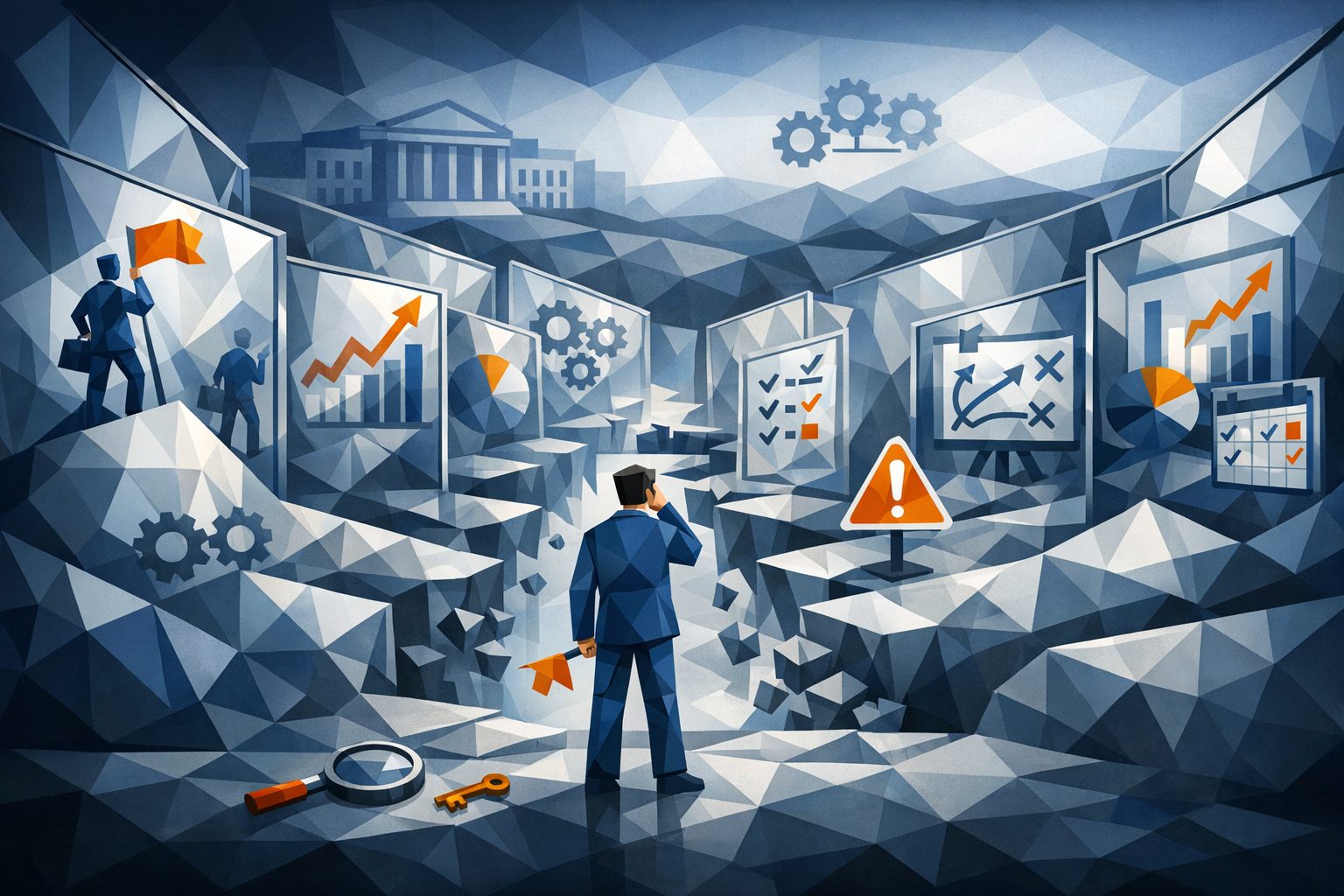
The well-equipped company that malfunctions magnificently
There is something deeply fascinating in the ability of modern companies to invest millions of euros in project management software while continuing to deliver late, blow their budgets and lose their customers with metronomic regularity. It is not a question of bad tools. It is a question of bad diagnosis: we look for a technological answer to problems that are, by nature, human, relational and organizational.
According to a Project Management Institute study published in 2023, nearly 70% of business projects fail to meet their initial objectives in terms of deadlines, budget or scope. Meanwhile, the global project management software market passed $6 billion in 2022 and continues to grow. These two curves rising together (spending on tools and project failure rates) actually tell the same story: that of a persistent confusion between the tool that organizes tasks and the human skill that governs, steers and manages. Jira can track a ticket. It cannot decide in place of a director who avoids making a call. This is a subject I have already covered in a previous article, on the successes and failures of projects.
The real question is therefore not whether your software is good (it is, for what it was designed to do). The real question is to understand what it will structurally never do, and why continuing to ignore it costs billions of euros every year in aborted projects, customer-supplier conflicts and the silent disengagement of teams.
Project management software covers only a tiny part of operational reality
First of all, tools must be put back in proportion. Project management software, however sophisticated, covers only a fraction of what constitutes the real operational management of a company. It manages tasks, deadlines, resources assigned to a defined scope. What it does not touch is the essential: strategy, company culture, quality of management, trust between teams, clarity of responsibilities, consistency of decisions and the ability of leaders to arbitrate under pressure.
Imagine a conductor who invested in the best music stand on the market, with built-in LED lighting, motorized adjustment and digital synchronization with the musicians. The stand is excellent. But if the conductor cannot conduct, if the musicians do not respect each other, if the program was chosen without regard for the available instruments, the concert will be bad. The stand has nothing to do with it, and buying a more expensive one will not change the problem.
This is exactly what happens in thousands of organizations that deploy Jira, Monday.com, ClickUp or Asana. This software organizes, tracks, visualizes and alerts with real efficiency within its scope. But that scope is narrow. It perhaps represents 10 to 15% of what really determines the success or failure of a project. The rest (governance, strategic steering, quality of management, customer relationship, team cohesion) takes place entirely outside these tools, in offices, corridors, meetings and conversations that no software has ever been able, or willing, to capture.
Governance: the big blind spot your project management software does not see
Project governance is the set of rules, decision-making bodies and escalation processes that allow a project to stay aligned with its strategic objectives. It is a human, political, organizational subject. And that is precisely why no project management software addresses it, measures it or handles it: because it cannot.
When a software vendor gives you a demonstration, it shows you impeccable Gantt views, smooth Kanban boards, automated workload reports. What it never shows you, because its product has no feature for it, is how to resolve a disagreement between two business directors over the priority of a deliverable. It does not show you how to manage the conflict between the IT department that wants more time and the customer who wants delivery yesterday. Above all, it does not show you how to compensate for the absence of an executive sponsor genuinely involved in decisions. Such situations are not addressed with an extra form field or a new ticket status. They are addressed with governance, authority and managerial courage.
The case of the British NHS IT program, the National Programme for IT, remains one of the most edifying examples of recent history. Launched in 2003 with a pharaonic ambition: digitizing the patient records of the entire English health system, it was abandoned in 2011 after swallowing £10 billion. There was no shortage of tracking tools. Governance, on the other hand, was catastrophic: fragmented decisions, diluted responsibilities, no unified vision between the suppliers, the hospitals and the government. No software was at fault. It was the human failures of steering and governance that killed the project, while the dashboards kept displaying reassuring progress.
What project management software reveals without being able to treat
There is nevertheless a right and productive way of looking at project management software: not as a solution to human problems, but as a revealer. Well-deployed software brings to light, with a sometimes salutary brutality, everything that malfunctions in an organization. Tasks piling up with no owner. Milestones slipping without anyone reacting. Dependencies between teams never formalized. Decisions on hold because nobody has the authority (or the courage) to make them.
This diagnosis is valuable. Provided it is read for what it is: the reflection of a human and organizational malfunction, not a setting to be reconfigured in the tool. The classic mistake is precisely to modify statuses, views or indicators so that the dashboard shows more reassuring colors, rather than addressing the root causes that the tool had the lucidity to highlight. We treat the thermometer instead of the fever. And meanwhile, the governance problem keeps growing.
Real operational steering rests on a rare and increasingly neglected human skill. Tracking a project means recording what has happened. Steering a project means anticipating, deciding and correcting the trajectory in real time. Project management software does the first very well. Only well-trained, well-positioned and genuinely empowered men and women do the second. And this distinction, however obvious on paper, is systematically erased in organizations that confuse having a tracking tool with having steering.
Employee disengagement: the wound that Kanban does not heal
Let us now talk about one of the most costly and least visible consequences of this structural gap: team disengagement. According to the latest Gallup report on the state of engagement worldwide, barely 23% of employees in the world say they are actively engaged in their work. In France, this figure falls to even more worrying levels, ranking the country among the least engaged in Europe. And in project environments, this disengagement has a direct cost: delays, errors, staff turnover, loss of organizational memory.
This disengagement is not born of bad software. It is born of failing management, a lack of recognition, an absence of meaning and a feeling of powerlessness in the face of decisions taken without consultation. It is also born, precisely, of the overload of poorly thought-out tools: when an employee has to juggle an instant messenger, a CRM, an ERP, project management software, a document platform and a reporting system (each with its own logic, its own updates and its own mandatory training), they do not gain in efficiency. They gain in cognitive fatigue and in the feeling of no longer knowing what they are really working for.
No dashboard measures this fatigue. No project management software detects it, addresses it or resolves it. Management has sometimes found in this software a comfortable way of delegating what cannot be delegated: the difficult conversation, the honest feedback, real listening. Why go and talk to a team member about their overload when you can check their ticket completion rate? The result is an impoverishment of the human bond in teams that no dashboard can measure or compensate for. And disengagement keeps settling in silently, far from Gantt views and well-planned sprints.
Customer-supplier conflicts: when project management software documents what it failed to prevent
The other major human problem that project management software never fills is the gradual deterioration of the relationship between customer and supplier. This deterioration almost always follows the same scenario: a contract signed with enthusiasm, first meetings full of goodwill, collaborative tools carefully shared, and then (gradually) trust crumbles. Deadlines slip, scopes expand without an amendment, misunderstandings accumulate, and communication that was fluid becomes formal, defensive, then openly conflictual.
At this stage, project management software no longer plays its role as a facilitator. It becomes an instrument of proof. Exchanges are archived. Approvals are screenshotted. Old versions of the schedule are dug up to establish responsibilities. The project is no longer managed: it is documented to serve as an argument in a future dispute. And the tool, which was never meant to manage trust, the relationship or human communication, finds itself instrumentalized in a role for which it was not designed.
France is seeing a significant increase in inter-company mediations linked to conflicts over IT and digital transformation projects. The Centre de Médiation et d’Arbitrage de Paris (CMAP) reports that technology disputes are a growing share of its activity. These conflicts could have been avoided, not with better project ticketing software, but with clearer contractual governance, better-defined validation milestones, and above all a culture of preventive dialogue. These skills are relational and organizational. They are learned, cultivated and managed. They cannot be bought as SaaS.
AI on top of all this: a real opportunity, but an absolute condition
And then, as a logical sequel to this evolution, came Artificial Intelligence. And it is a real opportunity for project steering, provided one understands what it can and cannot do. The promises are solid: prediction of slippage risks, resource allocation recommendations, early detection of weak signals, intelligent meeting summaries. In a structured environment, these capabilities can significantly transform the quality of steering.
But AI inherits exactly the gaps of the system it relies on. If the data fed to it do not reflect operational reality (and they do not, in almost all organizations where governance and steering are failing), then AI will produce recommendations that amplify and systematize these failures. Computer scientists have an acronym for this phenomenon, as old as computing itself: GIGO, Garbage In, Garbage Out. This principle has not aged a day with AI. It has simply taken on a new dimension, because the prediction errors of a poorly fed AI are not perceived as correctable human errors. They are perceived as objective recommendations produced by a system reputed to be superior to human judgment. That is where the original gap in project management software becomes truly dangerous.
Data quality: what AI requires humans to do first
The condition for effective AI in a project steering context is not the quantity of data available. It is its quality, relevance and representativeness. It is infinitely better to have fifty reliable indicators, updated in real time and aligned with the real decision-making stakes, than five thousand fields half-filled by people who do not understand why they are asked to fill them in. And this quality does not fall from the sky: it is the result of prior human work on definition, data governance and team training. That is, exactly the steering and management work that software has never been able to do in place of people.
Microsoft learned this lesson the hard way with Cortana, its intelligent assistant that was meant to revolutionize team productivity. Despite colossal investments, the software was gradually sidelined, for lack of sufficiently coherent and contextualized data to produce truly relevant recommendations. It was not the algorithm that was at fault. It was the absence of upstream data governance. AI, when well fed by an organization that has first solved its steering and responsibility problems, can become an exceptional copilot. When it is not, it becomes a generator of false certainties dressed up as algorithmic objectivity, placed on top of an already failing system.
What highly gifted profiles see that others refuse to see
Highly gifted profiles in a business context often have a characteristic that is particularly uncomfortable for their organizations: they perceive the systemic contradictions that others accept out of habit or conformism. A highly gifted profile in a steering meeting will be the one who asks why the dashboard shows "green" on every indicator when three customers have just escalated their dissatisfaction directly with management. They will be the one who points out that the AI recommends lengthening the sprint when the real problem is a governance deficit on business priorities. Above all, they will be the one who says out loud what everyone perceives in silence: that the tool measures activity, not results, and that behind the dashboard’s reassuring colors are hidden human problems that nobody has yet had the courage to address.
These profiles are often marginalized, precisely because they refuse to subscribe to the collective illusion that software addresses the real issues. Yet their frustration is the most valuable alarm signal an organization can receive. It indicates that the gap between operational reality and its representation in project management software has become untenable. And when they leave (as they often end up doing), they take with them the one thing that no software can capture: the ability to read reality as it is, and not as the dashboard represents it.
Putting everything in its place: people first, tools second
The good news is that the solution is not to give up project management software or to deprive ourselves of AI. It is to rebuild the order of priorities, the one that should have been respected from the start: first people, their responsibilities and their relationships, then the processes that structure them, finally the tools that serve them. In that order, and not the reverse.
It starts with accepting that project governance is a human and political issue before being a technological one. You need genuinely involved executive sponsors, steering committees that make real decisions, project managers who have the authority and the skills to arbitrate, not just to report. Sometimes it is even appropriate to get support in putting these structuring foundations in place. Once these foundations are laid, software regains its natural usefulness: amplifying what works, making visible what is already clear, accelerating what is already decided. And AI, fed with clean data produced by an organization that truly governs, then becomes the steering lever of unprecedented power that it promises to be.
It also means rehabilitating conversation as the first management tool. The best indicator of a project’s progress is not the automated burndown chart. It is the honest answer of a team member to the question "are we going to make it, and if not, what is stopping us?" This conversation costs nothing. It requires no SaaS subscription. And it produces more decision-making intelligence in ten minutes than twelve months of logs in a project ticketing tool. AI can then amplify this intelligence. Never create it. Never replace it.
Conclusion: software amplifies. Humans govern, steer and manage.
Project management software has a structural gap, and it is not accidental: it was designed to organize tasks, not to govern organizations. It was designed to track activities, not to manage teams. It was designed to visualize data, not to create trust between a customer and its supplier. This gap will never be filled by an update, a new module or an additional layer of AI, because it is in their very nature.
Accepting this reality is the first step towards real operational performance. The organizations that will succeed lastingly with their projects in the coming years will not be those with the best tool. They will be those who have understood that governance, steering and management are non-delegable human responsibilities, which software and AI come to serve once these responsibilities are clearly assumed. And there, on that ground, they will indeed work wonders.
Sources
Project Management Institute (PMI) – Pulse of the Profession 2023: Power Skills, Redefining Project Success, PMI Global, 2023.
Standish Group – CHAOS Report – Beyond Infinity, The Standish Group International, 2022. (report available on the publisher’s website)
Gallup – State of the Global Workplace 2023 Report: The Voice of the World’s Employees, Gallup Press, 2023.
National Audit Office (UK) – The National Programme for IT in the NHS: an update on the delivery of detailed care records systems, HC 888 Session 2010–2011, May 2011.
McKinsey & Company – Delivering large-scale IT projects on time, on budget, and on value, McKinsey Global Institute, October 2012.
Gartner – Market Guide for Project and Portfolio Management Applications, Gartner Research, 2023. (access restricted to Gartner subscribers)
Systèmes d’Information et Management – L’échec des projets SI : entre complexité technique et déficit de gouvernance, Revue SIM, vol. 27, no. 2, 2022.
Centre de Médiation et d’Arbitrage de Paris (CMAP) – Rapport annuel sur les médiations commerciales, CMAP, 2022.
Harvard Business Review – Why Your IT Project May Be Riskier Than You Think, Bent Flyvbjerg & Alexander Budzier, HBR, September 2011.
Gartner – Data Quality Market Survey: The Business Value of Trusted Data, Gartner Research, 2022. (access restricted to Gartner subscribers)
Kahneman, Daniel – Thinking, Fast and Slow, Farrar, Straus and Giroux, 2011. (References to cognitive biases applied to managerial decisions.)
Flyvbjerg, Bent – How Big Things Get Done: The Surprising Factors That Determine the Fate of Every Project, Macmillan Publishers, 2023.